
WELCOME BONUS 300%
UP TO €2000 + 100
FREE SPINS
UP TO €2000 + 100
FREE SPINS
Home → Blackjack
Blackjack at Godz Casino
Split Aces: Only One Card per Hand
In a split-aces situation, each ace receives one card only, and resplitting aces improves the return by 0.08 percentage points. The rule matters because aces carry the strongest starting value in blackjack, and the option to split them again adds a small but measurable amount to the player's long-run expectation on each hand.
Against a base game with a 0.46% house edge on six decks with S17 and DAS, that 0.08 percentage point gain lowers the effective edge to roughly 0.38%. On €100 of total stakes, the difference between having and lacking this rule is about €0.08 in expected loss, a small amount that compounds across thousands of rounds for a regular player.
For beginners, the takeaway is that split aces usually produce two hands that cannot be hit or doubled further, so the outcome is decided by the single card each hand receives. The value of resplitting aces is real but modest, worth about 0.08 percentage points of return, and it only applies when the rules explicitly allow a second split of aces.
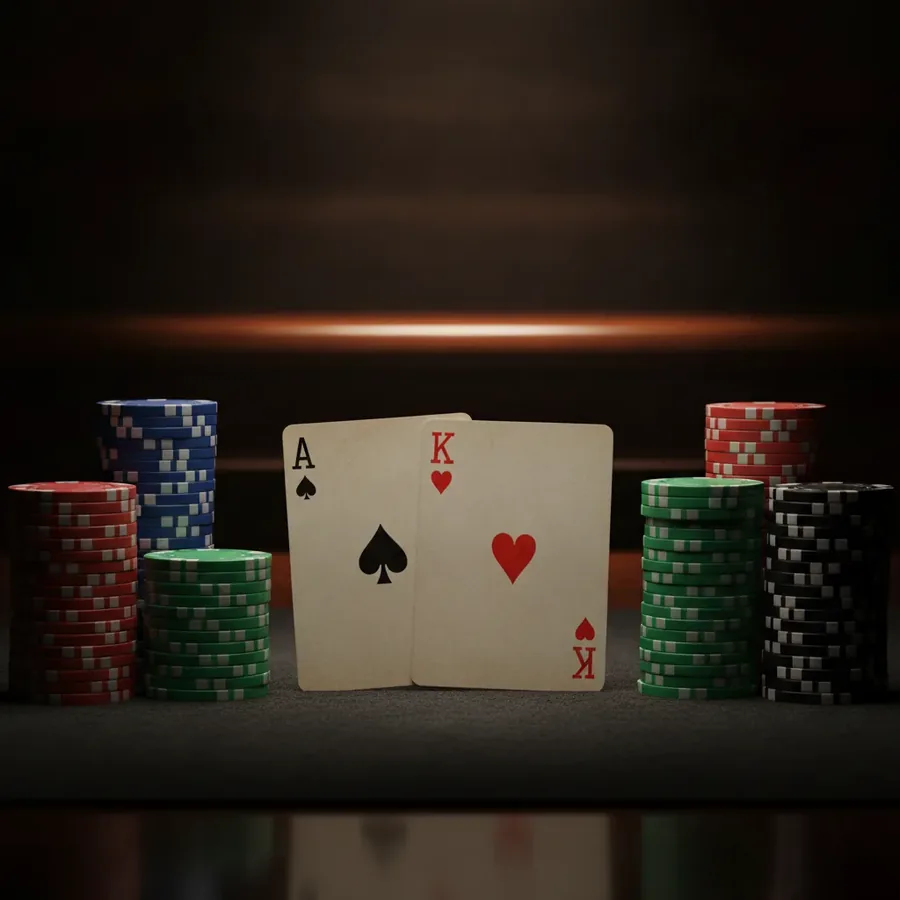
What the Hole Card Means at a Live Table
A hole card is the dealer's face-down second card in blackjack, and its handling shapes the entire hand. In a six-deck game with S17 and DAS, the house edge stands at 0.46%, and the dealer's soft 17 rule alone shifts that edge by 0.22 percentage points when the dealer hits instead of stands.
When the dealer shows an ace, a separate insurance side bet of up to 50% of the main bet becomes available. That bet pays 2:1 but carries a 7.47% house edge over six to eight decks, meaning €100 of insurance stakes costs about €7.47 on average, and basic strategy always declines it except for card counters at a true count of +3 or higher.
The RTP of that variant is 99.56%, slightly above the 99.47% of Infinite Blackjack, so the visible hole card sits inside a game with a return that is marginally more favourable than its stablemate.
Infinite Blackjack vs the Classic Seven-Seat Table
Infinite Blackjack from Evolution offers unlimited seats, a bet range from €1 to €5,000, and four side bets: Any Pair, 21+3, Hot 3 and Bust It. Its RTP is 99.47%, which sits below the 99.56% of Lightning Blackjack but above the 99.54% of a six-deck game with S17, DAS, DOA and a 3:2 payout.
A classic seven-seat table caps the number of players, whereas Infinite Blackjack removes that cap entirely and lets every player bet on the same dealt hand. The trade-off appears in the four side bets, which are separate wagers with their own house edges, so a player who takes all four adds extra cost beyond the main bet on each round.
Blackjack Party from Evolution sits between the two formats, with a bet range from €1.00 to €1,000 and two hosts. For a beginner, the practical choice is between the €1 to €5,000 range of Infinite Blackjack and the lower €1.00 to €1,000 ceiling of Blackjack Party, with the RTP of 99.47% against the party table's atmosphere as the main differentiator.
A Side Bet Every Round: The Budget Lasts 30 Rounds
A player who stakes €10 on the main bet and adds a €5 insurance side bet every round commits €15 per round. Over 30 rounds that is €450 of total stakes, and the 7.47% house edge on the insurance portion alone costs about €11.21 across those 30 rounds, before any main-bet result is counted.
Insurance is only offered when the dealer shows an ace, so the side bet does not appear every round in practice. When it does, the 2:1 payout on a €5 stake returns €15 on a win, but the long-run return of 92.53% means €100 of insurance stakes costs €7.47 on average, which is far higher than the 0.46% edge on the underlying six-deck game.
Basic strategy declines insurance in every situation except for card counters at a true count of +3 or higher. A player who skips the side bet keeps the full €10 main-bet budget for the base game, where 30 rounds at €10 is €300 of stakes and the expected cost at a 0.46% edge is about €1.38.
Blackjack variants at a glance
| Variant | Payout | House edge | Rule | RTP |
|---|---|---|---|---|
| Blackjack 6:5 payout instead of 3:2 (6 decks) | Blackjack 6:5, win 1:1 | 1.85% | Replacing 3:2 with 6:5 adds exactly +1.39 percentage points to the casino's edge – more than any other rule change. On a €10 bet a blackjack pays €12 instead of €15. | 98.15% |
| Blackjack Single deck, classic rules, 3:2 | Blackjack 3:2, win 1:1 | 0.15% | Fewer decks = lower edge; one deck gives about −0.48 percentage points compared with 8 decks. Often offset by a 6:5 payout. | 99.85% |
| Blackjack Liberal Vegas Strip (liberal rules, 3:2) | Blackjack 3:2, win 1:1 | 0.28% | The most player-friendly rule set: S17 + DAS + resplit + late surrender. Standard deviation 1.15 | 99.72% |
| Blackjack Split / double / H17 – rule effects | Double – stake ×2 with one card; split – up to 4 hands; split aces usually get one card each. | H17 +0.22 percentage points; RSA −0.08 percentage points; DAS −0.14 percentage points | Dealer hitting soft 17 lowers RTP by 0.22 percentage points; resplitting aces improves it by 0.08 percentage points; doubling after a split improves it by about 0.14 percentage points; 6 decks instead of 8 – about 0.02 percentage points. | n/a (rule modifiers) |
| Blackjack Surrender (late surrender) – rule effect | 50% of the stake returned | −0.08 percentage points | The player gives up the hand after the dealer has checked for blackjack and loses half the stake. Improves RTP by about 0.08 percentage points. Early surrender is worth much more (up to −0.6 percentage points) but is extremely rare. | n/a (rule modifier) |
| Blackjack Insurance (6–8 decks) | Insurance 2:1 | 7.47% | Separate side bet of up to 50% of the main bet when the dealer shows an ace. Basic strategy ALWAYS declines it (except for card counters at a true count ≥ +3). With a single deck the edge is ≈ 5.88% | 92.53% |
Splitting Eights vs Standing on 16
A pair of eights splits into two hands, and the split rule set allows up to four hands from one original pair, with the player committing a second stake equal to the first. The split bet carries stake ×2 per hand, so a €10 base bet becomes €20 at risk before any card is drawn.
Against that, standing on 16 leaves the hand unresolved against a dealer upcard, and the dealer hitting soft 17 adds +0.22 percentage points to the house edge. On a €10 stake, that rule alone costs roughly €0.02 per round on average across many rounds, so the split route is not the automatic loss it looks like.
Doubling after a split improves the return by about 0.14 percentage points, and resplitting aces adds a further 0.08 percentage points. A player who splits eights and then doubles on each resulting hand puts four units on the table; the rules, not the cards, decide whether that exposure is worth it.
Which Rule Variants the Software Shows
Blackjack Liberal Vegas Strip runs a 99.72% RTP with a 0.28% house edge, built on S17, DAS, resplit and late surrender. That edge is the lowest of the rule sets on display, so €100 of stakes costs €0.28 on average, against €0.46 on the standard 6-deck S17 DAS DOA table at 99.54%.
A second format, Blackjack 6:5, replaces the 3:2 payout and pushes the house edge to 1.85% on six decks. On a €10 bet a blackjack pays €12 instead of €15, which is a €3 shortfall every time the hand lands, and the rule change alone adds exactly +1.39 percentage points to the casino's edge.
Blackjack Single deck, classic rules, 3:2 sits at 99.85% RTP and a 0.15% house edge, with one deck worth about −0.48 percentage points against eight decks. A 6:5 payout on that single-deck game would erase the gain, so the payout line matters as much as the deck count.
Insurance vs Even Money When You Hold Blackjack
Insurance is a separate side bet of up to 50% of the main bet, offered when the dealer shows an ace, and it pays 2:1. On a €10 main bet the insurance stake is €5, returning €10 plus the €5 stake if the dealer holds blackjack; the side bet carries a 92.53% RTP and a 7.47% house edge across six to eight decks.
Basic strategy always declines insurance, because the 7.47% edge is the cost of the cover. At a single deck the same side bet carries an edge of about 5.88%, still above the main game's 0.15% to 0.46% range, so the decline holds even in the friendlier format.
Even money on the player's own blackjack is the same wager in different clothing: the player takes a 1:1 payout instead of risking the 3:2 return on a push against a dealer blackjack. Taking even money locks €10 on a €10 stake, while the 3:2 payout would deliver €15 on the same hand when the dealer does not hold blackjack.
Ignoring the Basic Strategy Chart: 1 Percent Wasted
The standard six-deck S17 DAS DOA game at 99.54% RTP and a 0.46% house edge assumes basic strategy on every decision. That figure is reachable only when each hand follows the chart; a player who ignores it hands back part of the 0.46% and can drift toward the 1.85% edge of the 6:5 format.
The gap between the two rule sets is 1.39 percentage points, exactly the amount the 6:5 payout adds to the casino's edge on six decks. Over €100 of stakes the difference is €1.39, and over €1,000 it is €13.90, which is why the payout line and the strategy chart are read together rather than separately.
Blackjack Liberal Vegas Strip at 99.72% RTP and a 0.28% house edge rewards the same discipline with a lower cost per hand. Its standard deviation of 1.15 describes the spread of results around that average, so the 0.28% is a long-run figure over hundreds of thousands of hands, not a per-session forecast.
Doubling After a Split: Which Tables Allow It
Doubling after a split, or DAS, improves the return by about 0.14 percentage points, and it appears in the Blackjack Liberal Vegas Strip rule set at 99.72% RTP and a 0.28% house edge. The same permission is part of the six-deck S17 DAS DOA game at 99.54% RTP and a 0.46% house edge.
Without DAS the player splits eights into two hands and can only hit them, which removes the option to double on a favourable total. Doubling itself puts stake ×2 on the table with one card, so the rule changes how much money a split can absorb: €10 per hand becomes €20 when the double is allowed.
Resplitting aces adds a further 0.08 percentage points, and the split rule permits up to four hands from one pair, with split aces usually receiving one card each. A table that allows DAS and resplit therefore carries a lower edge than one that allows neither, and the 0.14 percentage points is the measurable part of that difference.
Place Side Bets Before the Cards Are Dealt
Blackjack Insurance is a side bet of up to 50% of the main bet, placed when the dealer shows an ace, and it pays 2:1. A side bet is a wager separate from the main hand, resolved on its own condition rather than on the player's total against the dealer's. On a €10 main bet the insurance stake can reach €5, and a winning insurance bet returns €15, meaning the €5 stake plus €10 profit.
The insurance bet carries an RTP of 92.53% and a house edge of 7.47%, so for every €100 staked on insurance the casino keeps €7.47 on average. Compared with the 99.54% RTP of six-deck blackjack with S17, DAS, DOA and a 3:2 payout, insurance costs the player far more per euro wagered. With a single deck the insurance edge falls to about 5.88%.
Basic strategy always declines insurance, and the exception is a card counter at a true count of at least +3. A beginner following basic strategy therefore places no insurance bet at all, keeping the €5 aside and accepting the occasional dealer blackjack. The 2:1 payout looks generous, but the 7.47% house edge makes it the most expensive wager on the table.
16 vs 10 played incorrectly: most common error
A hard 16 against a dealer 10 is the hand where basic strategy and intuition diverge most often, and hitting remains the correct play under the six-deck S17, DAS, DOA rules with a 3:2 payout. That rule set returns 99.54% to the player and leaves a house edge of 0.46%, but only when basic strategy is followed on every decision. The house edge is the average share of each stake the casino keeps over the long run.
Standing on 16 against a 10 wins only when the dealer busts, and the dealer busts less often from a 10 upcard than from a 5 or 6. The 99.54% RTP figure assumes the player hits 16 against 10, so deviating from it raises the effective house edge above 0.46%. Blackjack Liberal Vegas Strip, with S17, DAS, resplit and late surrender, reaches 99.72% and a 0.28% edge on the same principle.
On a €10 bet the difference between the two rule sets is €0.18 per hundred hands at the stated edges, and a single repeated mistake on 16 against 10 costs more than that over a session. Late surrender is the one legal exit: the player gives up the hand after the dealer checks for blackjack and loses half the stake, worth about 0.08 percentage points of return. Surrender is not a hit or a stand, it is a third option that removes the hand entirely.
Bet Two Percent of Your Bankroll per Hand
A stake of 2% of the bankroll puts €2 on the table from a €100 balance, and the same proportion scales to €20 from a €1,000 bankroll. The house edge on six-deck blackjack with S17, DAS, DOA and a 3:2 payout is 0.46%, so €100 of stakes at that size costs €0.46 on average, and €1,000 of stakes costs €4.60. At 2% per hand a €1,000 bankroll covers 50 hands of €20.
The live tables set their own limits: Lightning Blackjack from Evolution accepts €1 - €2,500 per bet, Infinite Blackjack accepts €1 - €5,000, and Blackjack Party accepts €1.00 - €1,000. A 2% stake of a €1,000 bankroll, at €20, sits inside all three ranges with room to spare, while a €2,500 bankroll would put €50 on Lightning Blackjack, still far below its ceiling.
The 300% welcome bonus up to €2,000 plus 100 free spins changes the opening bankroll, and a €100 deposit produces €300 in bonus money and a €400 balance. Two percent of €400 is €8 per hand, roughly a quarter of the €20 stake a €1,000 bankroll would support. A larger balance at the same percentage raises the stake, so the proportion, not the euro amount, is the fixed part.
Double Down or Just Hit on 11
Doubling down on 11 means the stake is multiplied by two and exactly one more card is drawn, so a €10 bet becomes €20 with a single card to come. A simple hit keeps the original €10 stake and allows further cards. The double-down option is available on any first two cards under the S17, DAS, DOA rules that produce a 99.54% RTP and a 0.46% house edge.
Doubling after a split improves the return by about 0.14 percentage points, and resplitting aces improves it by 0.08 percentage points, which is why the DAS and RSA rules matter on a hand like 11. A split allows up to 4 hands, and split aces usually receive one card each. Doubling on 11 commits twice the money at a moment when the expected value favours it, but it also doubles the exposure on that hand.
On a €10 bet the doubled stake is €20, so a win returns the €20 stake plus €20 profit, while a loss costs €20 rather than €10. The extra €10 is committed before the card is seen, which is the trade the player accepts. Doubling after a split is not automatic: the rule must be offered, and its absence costs about 0.14 percentage points of return.
Soft vs Hard Hands in Practice
A soft hand contains an ace counted as 11, so soft 17 is an ace plus a 6, and the ace can drop to 1 without busting the hand. A hard hand has no ace counted as 11, so hard 17 cannot be reduced. The distinction matters because the dealer hitting soft 17 lowers RTP by 0.22 percentage points, and the six-deck S17, DAS, DOA, 3:2 rule set with a 99.54% RTP and a 0.46% house edge rests on the dealer standing on soft 17.
Resplitting aces improves the return by 0.08 percentage points and doubling after a split by about 0.14 percentage points, both of which apply to hands built around an ace. Six decks instead of eight adds roughly 0.02 percentage points, and one deck instead of eight adds about 0.48 percentage points. Blackjack Liberal Vegas Strip, with S17, DAS, resplit and late surrender, reaches 99.72% and a 0.28% edge on that combination.
Practically, soft 17 is a hand the player can hit without the risk of busting on the next card, because the ace falls to 1 if needed. Hard 17 offers no such protection, so the two hands call for different decisions even though both show 17. Standard deviation on the liberal Vegas Strip rule set is 1.15, a measure of how widely single-session results swing around the 99.72% return.
Contact
Live - online chat
Banking









Providers












Godz Casino 2026